Subject enrolment and sample collection
The study will enrol 6200 adult participants (aged >18 years) from the city of Legnano, a city in the Lombardy Region of Italy, with approximately 60,000 residents. Legnano offers a strategic location due to its proximity to Milan, manageable population size, and location within the Po Valley, a highly polluted area.
The 6200 participants will be divided into three phases:
- Discovery Set: 200 participants who will provide biological samples at two time points (T0 at baseline and T1 at 6 months). From this phase only, participants with cancer within the last 2 years, uncontrolled dysrhythmias, heart failure, valvular or myopericardial disease and major chronic diseases will be excluded.
- Tuning Set: 2500 participants who will provide samples at T0 only.
- Validation Set: 3500 participants who will provide samples at T0 only.
Participants will be recruited through community outreach, including promotion of the project during events in the city and ongoing recruitment at a central city location, supported by the local blood donation centres (Associazione Volontari Italiani del Sangue (AVIS) Legnano).
During enrolment, after signing the informed consent, participants will receive an appointment (approximately two weeks later) for biological specimen donation at the AVIS centre of Legnano. They will be also provided with a wearable device and asked to download the MAMELI-App (see section Wearable sensors and mobile app) and fill in a questionnaire on demographics, anamnesis, psychological wellbeing and lifestyle.
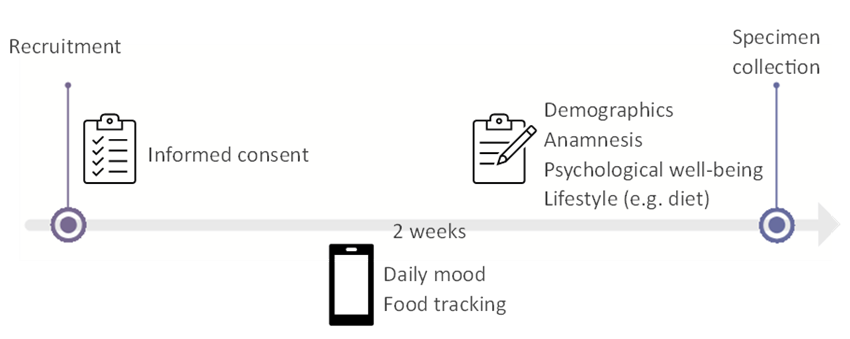
On the day of biological sample donation at AVIS Legnano, the questionnaire and the information recorded on the wearable device and the app will be downloaded and stored.
Intervention
An intervention will be conducted for participants who show a significant mismatch (>5%) between the RE methylation signature predicted by the MAMELI algorithm and the observed values. These individuals will be offered an intensive lifestyle modification program, including dietary changes, increased physical activity, and psychological support. Outcomes will be compared between the intervention and control groups based on RE methylation and health outcomes.